Food production is changing fast, and artificial intelligence is sitting at the center of that shift. From recipe development to factory floors and supply chains, AI now plays a role in decisions that once depended entirely on human trial, error, and experience.
The concern around job losses has grown alongside the technology, but the full picture inside the food and beverage sector is more layered than headlines suggest.
Instead of a simple story of replacement, the industry is moving through a mix of efficiency gains, role redesign, and new technical demands that didn’t exist a few years ago.
When Food Innovation Met AI
The early 2020s brought a surge in plant-based food demand. Companies rushed to build meat and dairy alternatives, but taste remained a stubborn problem. One major example came from Kraft Heinz, which faced pressure to create a plant-based mac and cheese that matched expectations.
Traditional product development in food companies often takes close to two years. In this case, the timeline dropped to around 10 months through the use of artificial intelligence developed with NotCo, a U.S.-based food tech company.
NotCo uses AI to scan ingredient combinations, sensory data, and consumer insights at a scale humans cannot realistically process. The system evaluates taste, texture, nutrition, cost, and production limits at the same time.
Alisia Heath, vice president of R&D at NotCo, explains the shift clearly:
“No human team can realistically evaluate millions of ingredient combinations while simultaneously factoring in taste, texture, cost, nutrition, manufacturing constraints, and consumer preferences.”
The role of R&D teams has started to change alongside this. Instead of running endless physical trials, teams now test AI-generated options before anything reaches a lab.
Heath also noted:
“Where R&D teams once spent the majority of their time running physical trials, they now direct AI, evaluating candidates computationally before anything reaches a lab bench.”
From Flashy Automation to Quiet Integration
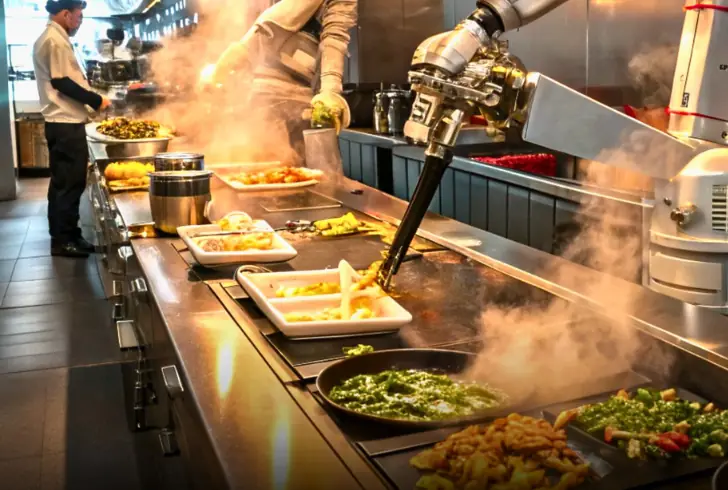
Early excitement around food tech often focused on visible automation. Concepts like cashier-less stores or fully robotic kitchens grabbed attention but struggled to scale. Amazon later shut down its AI-powered retail stores, and Zume, a robotics-based pizza startup, shut down after heavy investment losses.
The current phase of AI adoption looks different. It sits inside systems rather than front-facing experiences.
A report from BSI found that about one-third of food businesses now use AI in daily operations. Richard Werran, global director for consumer, retail, and food at BSI, described the shift:
“AI is now embedded across core food manufacturing operations rather than confined to pilot projects.”
This integration is influencing staffing decisions across the sector. Companies like Morrisons and Ocado have linked parts of recent job cuts to automation. Nestlé has also pointed to automation as part of its plan to reduce 16,000 roles. A broader industry survey suggests more than half of leaders see AI as a factor in reducing headcount.
Factory Floors Under Pressure and Change
Manufacturing roles have long relied on human skill, especially in food handling where products vary in shape, texture, and fragility. Tasks like sandwich assembly or produce sorting once resisted automation due to complexity.
That barrier is now shrinking. Machine vision systems powered by AI allow robots to recognize irregular shapes and handle delicate items with higher precision than before.
Millitec, a major supplier of food production automation, introduced AI-enabled systems in UK sandwich factories in 2020. Those systems now support production of more than 750,000 sandwiches per day.
Nigel Smith, CEO of TM Robotics, describes the shift in workforce structure:
“The manufacturers gaining the most from AI are those using automation to strengthen workforce capability, not simply reduce headcount.”
Repetitive physical tasks are becoming less common. At the same time, new technical roles are growing in importance, especially in system monitoring, machine oversight, and production optimization.
Jobs Most Exposed to AI in Food and Beverage
AI does not affect every role in the same way. Work tied to repetitive processes or heavy data handling shows the highest exposure. Across industry analysis, several roles stand out:
1. Product formulation roles relying on trial-and-error testing
2. Quality control positions based on manual visual inspection
3. Factory line roles focused on repetitive handling and assembly
4. Demand forecasting analysts using manual models
5. Nutrition and labeling specialists producing standardized outputs
6. Procurement analysts working with complex datasets
7. Maintenance roles reacting to breakdowns instead of predicting them
The pressure is not uniform, but the pattern is clear. Tasks that depend on repetition or structured data face stronger automation potential.
Data, Forecasting, and Supply Chain Intelligence
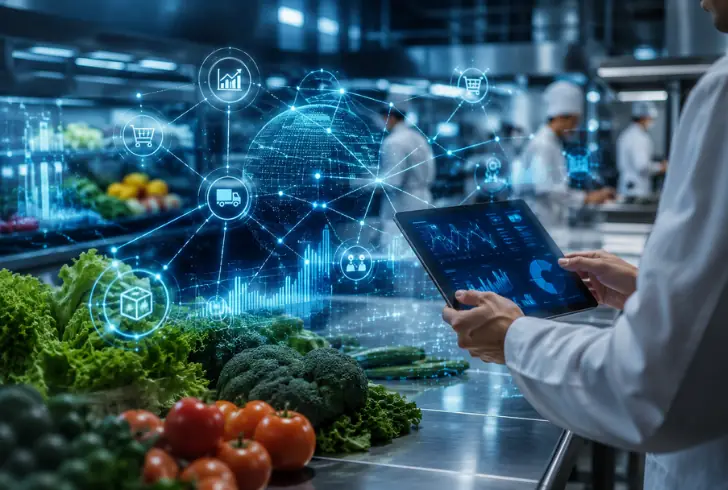
AI’s strongest advantage in food systems lies in processing large volumes of data. Forecasting demand and managing supply chains have become more advanced as systems absorb more variables.
Paddy Winters, food and drink consultant at Baringa, highlights how forecasting is changing. Traditional models often rely on partial datasets and manual adjustments. AI systems now pull from multiple live inputs, improving accuracy and responsiveness.
Smaller companies are also entering this space because costs have dropped. Systems that were once limited to large corporations are becoming more accessible.
Winters points to a key shift in economics:
“Labour’s been cheap enough that you can just still do it with people. But because the cost of labour has gone up, it’s changed the economic model.”
He also notes that many companies supplying private-label products avoided investment in advanced forecasting tools in the past because the business case was weak. That is now changing as margins tighten and efficiency becomes more valuable.
Risk, Resilience, and Smarter Product Design
Beyond factories, AI is reshaping product strategy and supply chain resilience. Mondra, a food intelligence company, works with supermarkets to assess ingredient risk and improve decision-making.
Chief product officer Tom Holden explains its purpose:
“We are all about managing price inflation and reducing the likelihood of a stock out. The two killer punches that every food company in the world is most fearful of.”
The system models disruptions triggered by geopolitical events and supply chain shocks. It also supports reformulation of products for cost, nutrition, and environmental impact.
In one case, Tesco used AI-assisted analysis to adjust a lasagne recipe. The updated product reportedly improved nutrition, reduced carbon impact, and increased profitability.
Holden notes a shift in capability:
“They could manage nutrition. But if you wanted to extend out into all the dimensions, they did not have the data. It was not available.”
This reflects a broader trend. AI is not replacing sourcing teams but giving them a wider set of signals to work with.
Maintenance and the Hidden Value of Uptime
While forecasting and formulation often get attention, equipment maintenance is becoming one of the most valuable AI applications in food manufacturing.
Unplanned downtime in factories leads to major financial losses. AI tools now track machine behavior and detect early signs of failure, helping teams shift from reactive repairs to preventive action.
AI commentator Berend Booms describes the value clearly:
“Once you answer that honestly, the role AI should play – and the role people continue to play alongside it – becomes considerably clearer.”
He also points to measurable impact:
“Even a modest 5% to 10% reduction in mean time to repair represents significant monetary value, quite apart from the productivity benefits.”
The focus here is not elimination of human roles. Instead, it is improved timing, better data, and fewer unexpected breakdowns.
The Human Element Still in Food Creation

Even with strong AI adoption, some roles continue to depend heavily on human taste and intuition. Culinary consultants still work closely with product development teams, especially in premium and creative food categories.
Jonny Bingham, co-founder of Bingham & Jones, describes the tension inside the industry. While businesses appreciate culinary expertise, cost pressure often drives decisions toward automation.
He explains:
“If big businesses can get that for cheap then that will always be their default position. Especially when business is difficult.”
Bingham also raises a limitation of AI in food creativity:
“You go to restaurants or watch TV, and everything is very sexy. Food has become almost porn for the masses. You only need to look on Insta or Tik Tok and it’s full of people doing great stuff with food. But when you reduce it to AI trying to create flavours, tastes, feelings, it doesn’t work.”
He adds a final perspective on balance:
“AI can give you insight and it can give you a starting place. But to make food really sexy again, it needs a human touch.”
AI in food and beverage is reshaping product development, factory operations, and supply chain decisions. Roles built around repetitive tasks and structured data face higher disruption, while positions focused on oversight, systems control, and decision support are evolving.
Areas like product creation, forecasting, maintenance, and logistics now rely heavily on data-driven tools that handle complexity at scale. Even with this shift, human input remains important in creativity, taste evaluation, and culinary judgment.
The industry is not removing people but redefining how human skills work alongside intelligent systems in a more data-focused environment.