
Nutrition sits at the center of modern health care, yet it remains one of the most overlooked areas in physician training across the United States. While diet-related conditions continue to rise, many medical graduates enter clinical practice without the skills needed to guide patients on something as fundamental as food.
This gap is no longer a minor concern—it directly affects patient outcomes, healthcare costs, and long-term public health.
At the same time, international education systems are offering a different perspective. By treating nutrition as a core component of medicine rather than an optional topic, these models highlight what is possible when science, clinical care, and prevention align.
A Growing Gap in U.S. Medical Education
Medical schools in the United States currently provide an average of just 17 hours of nutrition education. That number has dropped from about 25 hours in previous years, even as research linking diet to disease continues to expand.
More concerning, nearly 71% of medical schools fail to meet the recommended minimum of 25 hours. Some institutions offer fewer than 10 hours over four years. This leaves future physicians underprepared to address conditions that dominate clinical practice today.
Cardiometabolic diseases—driven largely by poor dietary patterns—cost the U.S. healthcare system close to $800 billion annually. Medicare carries a significant portion of this burden, especially through treatment for diabetes, obesity, hypertension, and cardiovascular disease.
Despite this reality, nutrition remains sidelined in many training programs. National curriculum reviews and frameworks from the Association of American Medical Colleges continue to flag this as a structural issue. The lack of nutrition training limits the ability to implement effective “food-as-medicine” strategies at scale.
Why Nutrition Training Matters
Research consistently shows that nutrition plays a direct role in both prevention and treatment. Diets centered on whole, plant-based foods and low in processed sugars and meats have been linked to lower risks of cognitive decline and chronic disease.
Clinical evidence also reinforces this connection. Studies indicate that individualized nutritional support can reduce mortality by about 27% in malnourished hospitalized adults. Even short, physician-led dietary counseling sessions have been shown to improve cardiometabolic health markers across populations.

Yet, many physicians report feeling unprepared to provide this guidance. They recognize the importance of nutrition but lack confidence in applying it during patient care. As a result, dietary counseling often remains underused, even though it offers strong preventive value.
National policy efforts, including the federal National Strategy on Hunger, Nutrition, and Health, now identify clinician nutrition competency as essential. Improving education in this area is not just an academic goal—it directly supports disease prevention, health equity, and cost reduction.
Signs of Progress in the U.S.
Momentum for change is beginning to build. In March 2026, the U.S. Department of Health and Human Services and the Department of Education announced that 53 medical schools across 31 states committed to providing at least 40 hours of nutrition education starting in the 2026 academic year.
This shift signals a new direction. While these commitments do not fully close the gap, they reflect growing recognition that nutrition must be integrated into medical training.
At the same time, the Accreditation Council for Graduate Medical Education plans to make nutrition education a requirement for residency and fellowship programs by 2026. The Association of American Medical Colleges is also working toward competency-based assessments to ensure consistent learning outcomes.
These developments suggest that nutrition is finally gaining attention as a core element of medical education rather than an afterthought.
Lessons from International Models
Global academic programs in food and nutrition sciences provide a valuable reference point. These programs approach nutrition as an interdisciplinary field that connects biology, clinical medicine, public health, and prevention.
Instead of isolating nutrition into a single course, international models weave it throughout the curriculum. Students learn how dietary patterns influence physiology, disease progression, and long-term health across the lifespan.
This integrated approach strengthens clinical reasoning. It helps future physicians understand how nutrition interacts with multiple systems rather than treating it as a separate topic.
European programs, in particular, emphasize the connection between daily habits and health outcomes. Nutrition is framed not only as a scientific subject but also as part of everyday life and preventive care.
In countries like Italy and other Mediterranean regions, nutrition is deeply embedded in cultural practices. Food is viewed as a foundation of health, not just a source of nutrients.
This perspective shapes how medical education is structured. Students are exposed to nutrition as both a technical discipline and a practical component of daily living. As a result, they develop a more intuitive understanding of how diet affects health over time.
This cultural context also supports interdisciplinary learning. Nutrition naturally connects with public health, clinical care, and lifestyle medicine, making it easier to integrate into training programs.
Moving Toward Competency-Based Learning
Recent efforts in the United States have identified 36 core nutrition competencies for medical students and physician trainees. These competencies cover key areas such as:
1. Foundational nutrition knowledge
2. Patient assessment and diagnosis
3. Communication and counseling skills
4. Public health awareness
5. Collaboration with nutrition professionals
This framework shifts the focus from hours spent in class to skills gained in practice. It reflects a more practical approach, ensuring that physicians can apply nutrition knowledge in real-world settings.
Importantly, the goal is not to turn physicians into nutrition specialists. Instead, training should equip them to recognize nutrition-related issues, provide basic guidance, and refer patients to qualified experts when needed.
This team-based approach mirrors how other specialties function in modern healthcare.
Integrating Nutrition Across the Curriculum
Some U.S. medical schools have already found effective ways to meet nutrition education goals. Rather than adding standalone courses, they integrate nutrition into existing subjects such as physiology, biochemistry, and clinical rotations.
This method reinforces the relevance of nutrition across different areas of medicine. It helps students see how dietary factors influence everything from cellular function to disease management.
International programs follow a similar structure, embedding nutrition throughout the educational experience. This consistency strengthens both understanding and application.
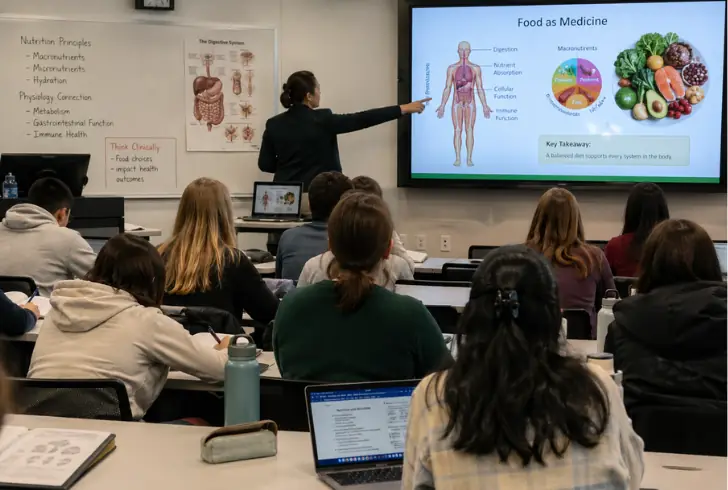
Hands-on learning is emerging as one of the most effective strategies for teaching nutrition. Culinary medicine programs combine classroom instruction with practical cooking experiences, allowing students to engage with food in a meaningful way.
Research shows that students who participate in these programs achieve higher competency in diet-related preventive cardiology. They also tend to improve their own eating habits, which can influence how they counsel patients.
This approach creates a direct link between knowledge and behavior. It reinforces the idea that nutrition is not just theoretical but deeply connected to everyday choices.
Addressing Barriers to Implementation
Despite growing interest, several challenges continue to limit progress in nutrition education.
Limited curricular time remains a major concern. Medical programs are already dense, making it difficult to introduce new content without removing existing material.
There is also a lack of standardized assessments, which makes it harder to measure competency across institutions. In addition, many schools face a shortage of faculty with specialized expertise in nutrition.
Competing priorities within medical education further complicate efforts to expand nutrition training. However, recent policy changes and institutional commitments suggest that these barriers can be addressed with coordinated effort.
A High-Impact Opportunity for Healthcare
Stronger nutrition education has a direct impact on patient care. It supports prevention, reduces chronic disease rates, and helps control long-term healthcare costs. Research shows that targeted nutrition interventions can lower mortality in hospitalized patients and improve outcomes in conditions such as diabetes and heart disease.
Better training also helps physicians communicate clearly with patients, offering practical, evidence-based dietary guidance during routine care.
Current medical training in the United States does not fully reflect the growing role of nutrition in disease prevention and management. In contrast, international education models show how integrating nutrition across disciplines can improve both knowledge and clinical application.
Recent policy efforts and institutional commitments indicate that change is underway. The focus now shifts to consistent implementation and placing greater value on nutrition within medical education. This shift can support better health outcomes and encourage a stronger focus on prevention in everyday care.